

What we cover

Retailers know loyalty is hard to win — and it’s even harder to keep. Today, the large majority of shoppers are “uncommitted customers,” spreading their trips across multiple retailers to maximize the value they receive from each transaction.
Back in 2024, we found that retailers who capture even one more visit from uncommitted shoppers could see a lift in annual revenue of 84% or more. That opportunity hasn't shrunk since — it's grown.
Our latest Consumer Spend Report demonstrates that macro factors like lingering price fatigue and tariff uncertainty are pushing consumers to spread their trips further, compare prices more, and rely on loyalty programs less. Furthermore, some retailer “best practices” are actually reinforcing this behavior rather than curbing it.
Uncommitted shopping is the standard — and it's becoming more entrenched in consumer behavior by the month. Retailers who understand what's driving it are best positioned to act.
How uncommitted customers are behaving
Let’s start with a baseline. In 2024, the average shopper visited three grocery stores, two gas stations, and four different restaurants each month. In 2025, that baseline only grew:
- 3.1 grocery stores/month (+8% YoY)
- 2.6 gas stations/month (+7% YoY)
- 3.2 convenience stores/month (+17% YoY)
- 4.0 restaurants/month (+3% YoY)
Shoppers were already spreading their trips widely last year. This year, they're spreading them even further.
Why uncommitment is accelerating
Two reinforcing causes are accelerating uncommitted shopping behavior: pressure and permission.
Pressure is being applied at the macro level. Stubborn inflation and cost fatigue have pushed consumers to stretch every dollar further. When we surveyed consumers from the general population, nearly half (49%) said that the economy got worse in 2025 compared to the year prior. Further, four in five (79%) changed their shopping behavior due to tariff-driven price increases — cutting spend, switching stores, and leaning harder on promotions.
Permission, on the other hand, comes from retailers themselves. In response to those same pressures consumers are facing, retailers invested heavily in digital access, delivery options, and loyalty programs — smart moves that kept customers engaged through a volatile period.
But there was an unintended consequence: those investments made it easier for customers to come in, and just as easy to leave. Better digital tools make comparing prices frictionless. Loyalty programs became so ubiquitous that having one is now table stakes, rather than a differentiator.
Retailers didn't create uncommitted behavior, but they inadvertently gave it room to grow.
Together, pressure and permission explain why uncommitted shopping is both more common in 2025 — and more entrenched.
The three traits that define uncommitted customers
Uncommitted shoppers are value-seeking
Unsurprisingly, uncommitted customers care about fair prices for the goods and services they buy. When we surveyed them, they told us that low prices were in the top two most important factors for choosing where to buy, no matter the retail category.
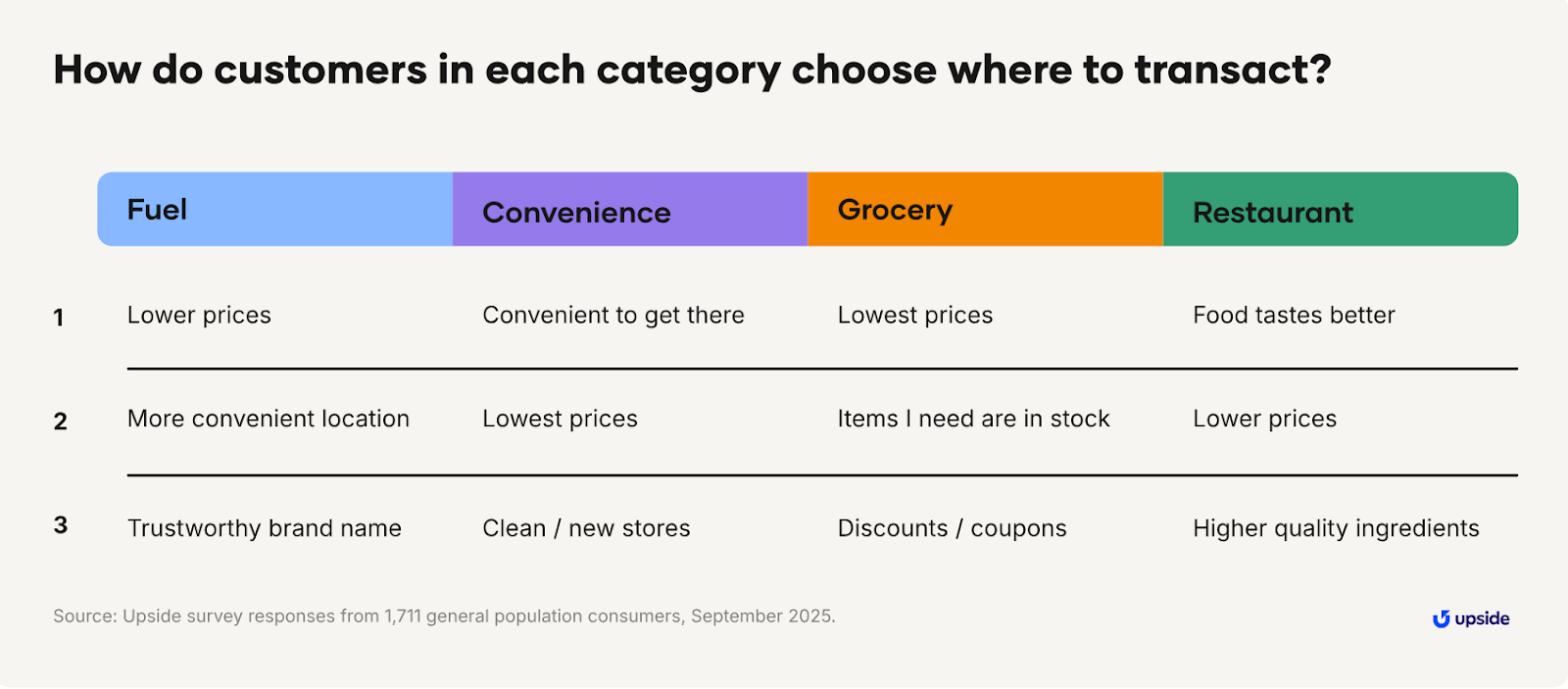
At the same time, “value” means much more than finding the cheapest option. A customer might value convenience, choosing to shop at the retailer closest to their house. They might value quality, choosing to bypass competitors in order to get the best selection. As you can see above, choosing a restaurant relies heavily on taste and dining preferences. It really all depends on the individual.
Behavior does, however, differ a bit based on household income. Those with higher earnings (which we define as more than $75,000 per year) tend to cut back more selectively, while those below do so out of necessity.
We’re calling this growing behavior gap the “income divide” — you might’ve also heard of it referred to as the “k-shaped economy.” In short, while average spending may appear steady, aggregate spending trends reflect a growing gap in how households are navigating value.
Uncommitted shoppers are digital
The phone is their shopping companion. Right at their fingertips, they have everything they need to compare prices, read reviews, and act on offers in real time. Frequent online grocery shoppers now buy from three times as many stores as in-store-only shoppers — a direct result of how easy digital tools have made comparison shopping.
The following percentages of customers make use of digital resources — like social media, search, online ads, and online reviews — to inform their decision-making processes. Across our key retail categories, it’s roughly half (or more) of all customers.
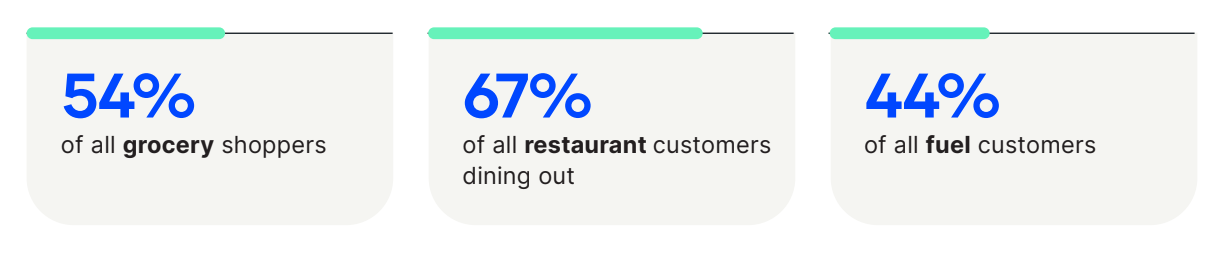
In 2025, the availability of digital comparison tools only expanded, and category boundaries are blurring — meaning your competition isn't just the retailer next door anymore.
Uncommitted customers are opportunistic
Since uncommitted customers make decisions about where to shop based on their lifestyle, that means deciding just hours (or even minutes) before they actually transact.
In 2024, roughly half of all grocery customers — both committed and uncommitted — told us they decide where to transact less than two hours before they actually go there. That was actually the lowest percentage of customers in the categories that we surveyed. In the restaurant industry, 66% of customers who dine out said they decide where to go less than two hours beforehand, and in fuel, 77% of respondents decide where to fill up less than two hours before doing so.
Here's what makes this especially challenging: eight in 10 consumers say loyalty is important to them — yet loyalty participation remains flat, and retailers themselves report no meaningful uptick in engagement.
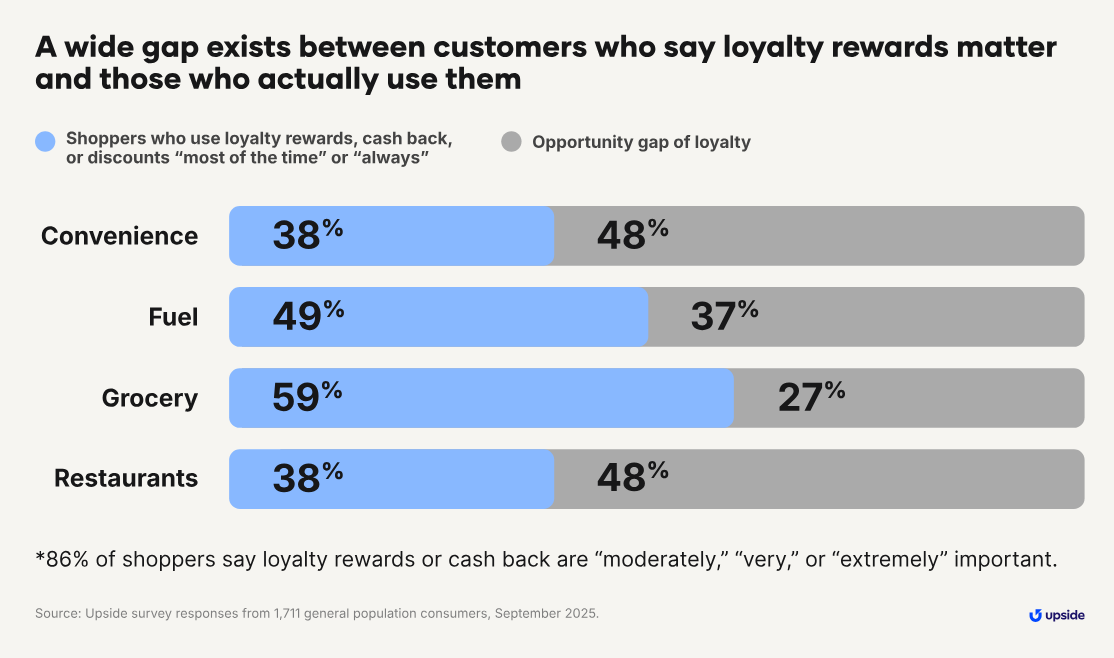
Higher-income consumers are actually more likely to use loyalty programs, suggesting that loyalty tools may be missing the customers who need the most motivation to return. The gap between what consumers say about loyalty and what they actually do with it is where opportunity lives.
Loyalty isn't counteracting uncommitted behavior. In many cases, it's running alongside it — and falling short.
Why this matters more in 2026
Although revenue growth is slightly up across convenience, grocery, and restaurants year-over-year, it's still trailing inflation. Retailers are working harder for thinner real gains, while customers are simultaneously becoming more selective about where they spend.
You can't out-promote your way out of this with blanket offers. You need to meet uncommitted customers where they are — individually, in the moment, with the right incentive.
Winning just one more visit from uncommitted customers remains one of the highest-leverage moves available. But the window to act is narrowing as cross-shopping accelerates and macro pressures compound. The path forward is habit formation, built on personalized engagement at the moment of decision.
Learn more about the uncommitted shopper in our annual Consumer Spend Report.