


Proven measurement with every transaction
Retailers shouldn’t have to guess what’s working. Upside shows proven, transaction-level impact on customer behavior and incremental profit

Trusted by retailers, validated by experts
Our measurement methodology has been tested and validated by thousands of our retail partners and industry-leading analytics firms.









True incrementality, proven attribution
Upside influences customer behavior with personalized offers and proves when those purchases are truly incremental for retailers. We continuously monitor your existing promotions and initiatives to ensure we’re complementing, not cannibalizing, your current efforts.
Let’s break down how it works
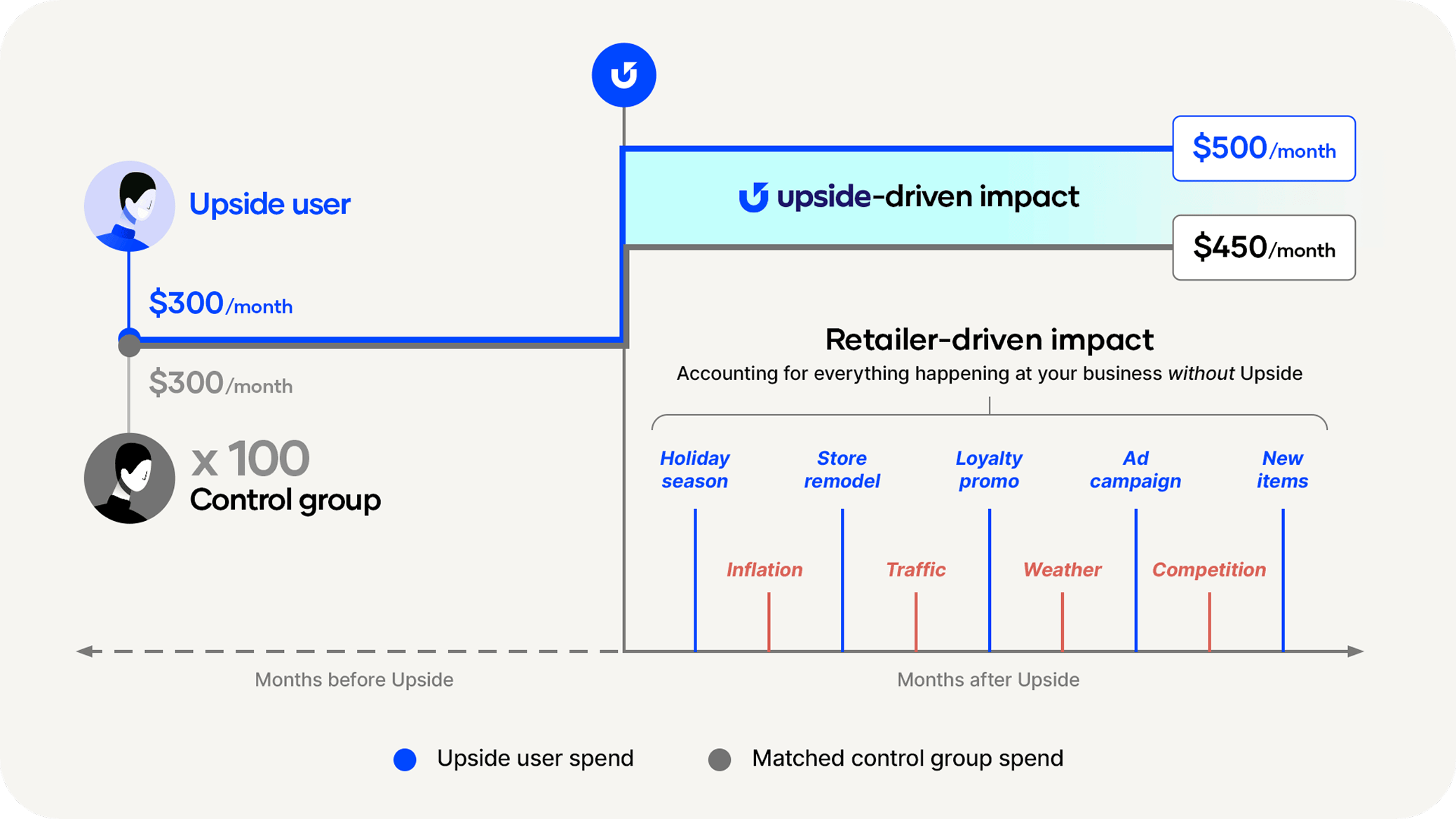
We measure impact using a test-versus-control approach. Each customer who uses an Upside offer is compared to similar customers who didn’t, so you can see how shopping behavior changed because of Upside.
Learn about the user
When a customer claims an Upside offer, we use retailer data to build a user profile based on shopping behavior.
Pair them with a control group
Next we find 10 to 100 non-Upside users with similar purchasing histories. Their average spend indicates what we expect from Upside users.
Measure true incrementality
Upside compares user spend to the control group. The difference is deemed incremental and attributed to Upside.
Dive deeper into our marketplace and how we measure impact
Only pay when you profit
Our offers align with your margins, so you only pay when results are proven to be incremental and net-new. See how our marketplace differs from other third-party channels.

(like delivery apps)
Measurable return on investment (not ROAS) on every transaction


Uses a profit-share cost structure
Deconflicts with current initiatives, never cannibalizes expected profit
See what’s working
You can track every verified transaction in Upside’s dashboard. Review purchase history, customer segments, incremental profit, and ROI in one place.




“In our first year on Upside, we earned $2.4M in verified incremental sales, and 85% of those customers were new or infrequent visitors."

Miko Angeles
Vice President, Fuel & Mobility, Coen Markets
Your questions, answered
How does Upside ensure retailers only pay for actual results?
Retailers only pay for proven, incremental results — never for sales they would have received anyway. Upside uses a test vs. control methodology to prove which sales are truly incremental. Upside’s platform creates control groups based on past spending patterns. By comparing an Upside user to a control group, Upside measures exactly what's new business versus what would have happened otherwise.
Upside retail partners receive detailed performance data, including:
- Incremental sales generated via promotions
- Promotion costs
- Profit share fees
Independent third parties and Upside retail partners have validated this approach. All program costs are based on measured results—not projections or estimates.
Does Upside guarantee performance?
Yes, the program is designed so that retailers only pay when they profit. Retailers will only ever pay for profit delivered by Upside that the retailer would not have otherwise captured. If an Upside-driven transaction is not incremental, the retailer doesn’t pay for it.
How is Upside different from traditional discounting programs?
Upside is designed to drive incremental, profitable growth — not discount existing behavior. Traditional discounting applies broad offers to all customers, often giving up margin on sales that would have happened anyway. Upside takes a different approach, using personalized promotions targeted specifically to new and infrequent customers who are less likely to visit without an incentive.
This means retailers increase foot traffic and transactions while protecting margin, because offers are focused on influencing customer behavior, not rewarding purchases that were already likely to occur.
What are the key benefits of using Upside for retailers?
Upside benefits retailers by bringing in new and repeat customers and incremental revenue — profitably. Upside’s personalized promotions nudge consumers to choose Upside retail partners over nearby competitors. This drives new foot traffic and increases retailers’ share of wallet.
Unlike traditional loyalty programs or blanket discounts, Upside’s offers are designed to drive transactions that retailers wouldn’t have received otherwise — all while protecting the retailer’s margin.
Upside runs automatically in the background, connecting millions of consumers with retailer partners without changing business operations. Every promotion is designed to be profitable. Because Upside uses a profit-sharing model, it only makes money when retailers do.

Request a demo
Request a demo of our platform with no obligation. Our team of industry experts will reach out to learn more about your unique business needs.


